what is the ratio of the current for v = 2 v to 0.5 v?
What is the Relationship betwixt Electric Electric current and Potential Deviation?
- When an electric charge is placed at a point in an electric field, information technology experiences an electrical force acting on it. Work is required to move the electric accuse in the electric field against this force. This charge is said to have an electric potential at that point.
- Effigy shows two points, A and B on an electric field line of a positively-charged sphere. Signal A, which is nearer to the sphere, has a higher potential than point B.
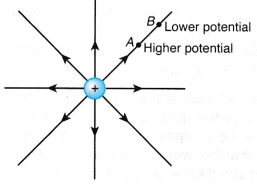
- When a positive test accuse is placed at bespeak A, the positive charge volition move away from indicate A (higher potential) to signal B (lower potential).
- If yous want to move the positive accuse from signal B to bespeak A, work or energy is required to move the charge against the electric field. This work done to motion one unit of charge from betoken B to point A is known as the potential difference betwixt the 2 points.
- Similarly, when a battery is connected to a bulb in a circuit, every bit shown in Figure, it creates a potential difference, that is, a difference in the potential energy of the charges in the conductors continued to its terminals. When the switch is off, the positive terminal, P is at a higher potential and the negative terminal Q is at a lower potential. When the switch is on, the potential departure between the 2 terminals causes the charges to flow beyond the bulb in the circuit and lite up the bulb.
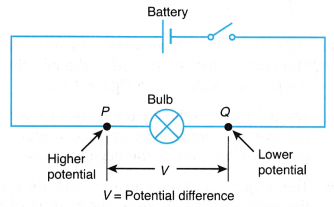
- The energy carried past the charges will be converted into other forms of energy such every bit light and heat energy in the bulb. So piece of work is washed when electrical free energy carried by the charges is dissipated as heat and light energy after crossing the bulb.
- The potential divergence between two points in an electric field is defined as the work done or the energy that would be required to move i coulomb of charge from one indicate to another.
- In symbols:
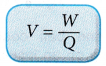 Where, 5 = potential difference (p.d.) in volt (V)
W = work washed in driving the accuse betwixt the ii points in joule (J)
Q = corporeality of positive charges in coulomb (C) - The SI unit of measurement for potential departure is volt (V).
- The potential divergence between two points in an electric field is one volt, if the work washed to motion one coulomb of charge betwixt the ii points is 1 joule.

People also ask
- What is Electric current?
- What is an electrical field and how is it created?
- Electromotive Forcefulness, Internal Resistance & Potential Difference of a Jail cell/Battery
- How series and parallel circuits are different?
- Relationship between Energy Transferred, Current, Voltage and Fourth dimension
- Power Rating and Energy Consumption of Diverse Electric Appliances
Relationship between Electric Current and Potential Difference Problems with Solutions
- When a charged metal dome of a Van de Graaff generator is discharged through a resistive wire, information technology is found that 2 C of charge passes through it and information technology dissipates 12 000 J of energy. What is the potential difference beyond the wire?
Solution:

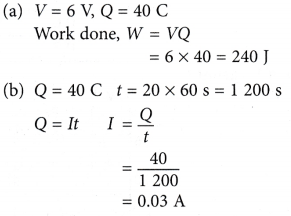
- In a closed circuit, a 6 Five battery is used to drive twoscore C of electric charges through a lite bulb.
(a) How much piece of work is done to drive the charges through the bulb?
(b) What is the current that flows in the excursion in 20 minutes?
Solution:
Relationship betwixt Potential Difference and Electric current E xperiment
Aim: To investigate the relationship betwixt current and potential deviation for a metal wire.
Problem: When a current passes through a usher such equally a metal wire, bulb and diode, electrical free energy is converted into heat energy causing a potential departure across the usher. What is the relationship between potential deviation beyond a conductor and the current that passes through it?
Hypothesis: When the current that passes through a metal wire increases, the potential difference beyond the metal wire increases.
Variables:
(a) Manipulated variable: Current, I
(b) Responding variable: Potential divergence, V
(c) Fixed variable: Length and blazon of metallic wire
Materials: 50 cm constantan wire (southward.due west.m. 24)
Apparatus: Ammeter (0 – 1 A), voltmeter (0 – 5 V), battery holder, three one.5 5 batteries, rheostat, switch, connecting wires
Method:
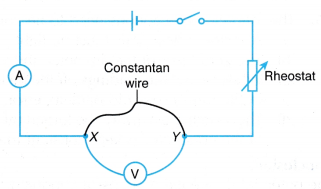
- The bombardment, ammeter, voltmeter and rheostat are continued in a circuit as shown in Effigy. The 50 cm constantan wire is continued across terminals X and Y.
- The circuit is switched on and the rheostat is adjusted until the ammeter gives a reading, I = 0.two A. The potential difference, V across XY is recorded from the voltmeter.
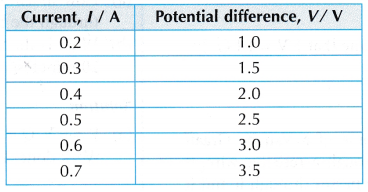
- Stride 2 is repeated by adjusting the rheostat to set the current at I = 0.3 A, 0.iv A, 0.5 A, 0.vi A and 0.7 A. The respective values of potential difference across the wire are recorded.
- All the values are recorded in a table.
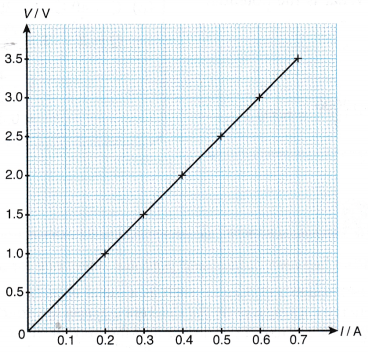
- A graph of V versus I is plotted. Both- axes must brainstorm from the origin.
Results:
- Tabulation of results.
- Graph of V confronting I.
Discussion:
- As more charges carrying electric energy passes through the conductor per unit fourth dimension, more than electrical energy is dissipated. Hence, the potential divergence, V across the usher increases with the electric current, I that flows through it.
- The graph of V confronting I is a direct-line graph that passes through the origin showing that the potential difference, V is direct proportional to the electric current, I (V ∝ I).
- The gradient or the ratio of V/I is abiding as current increases.
- A small current (less than 1 A) is used throughout the experiment then that the conductor is not heated upwards and its temperature tin be assumed constant.
- The following precautions need to be considered during the experiment:
(a) All wire connections must be tightly fixed and the length of the wire should not be too long.
(b) The zero error of the ammeter and voltmeter must be checked and adjusted.
(c) While taking the readings off the meters, make sure that the arrow is ever vertically above its epitome in the mirror to avoid parallax fault.
(d) The switch must always be turned off when not taking any reading. This is to ensure that the temperature of the usher is kept constant throughout the experiment.
Decision:
The potential difference, V across a usher increases when the electric current, I passing through it increases as long every bit the conductor is kept at a constant-temperature. The hypothesis is accustomed.
Source: https://www.aplustopper.com/relationship-electric-current-potential-difference/
0 Response to "what is the ratio of the current for v = 2 v to 0.5 v?"
Post a Comment